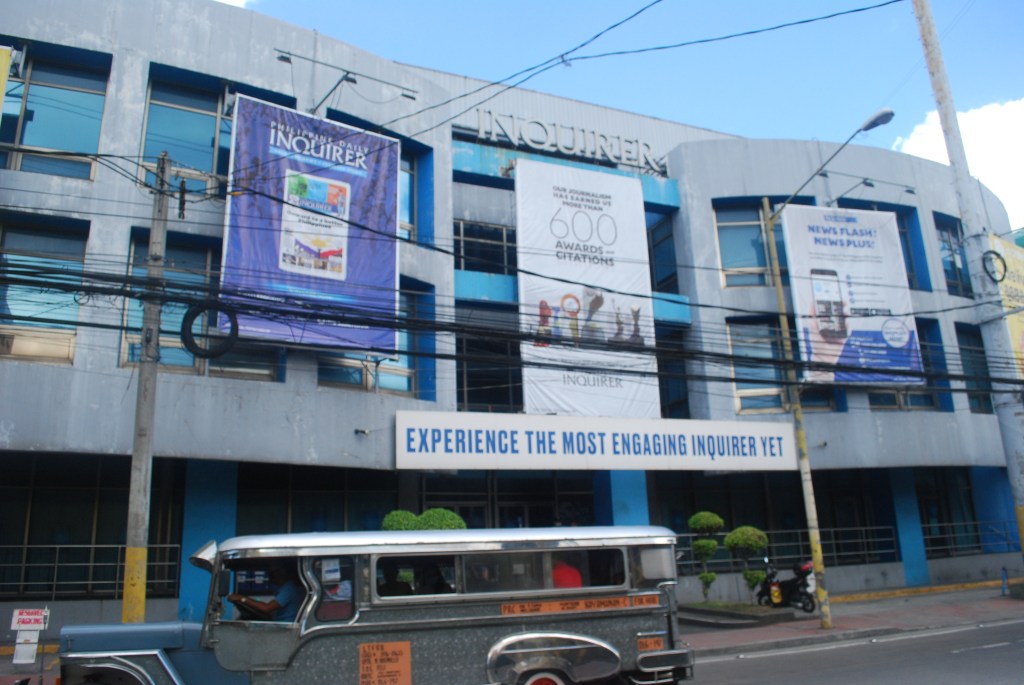
Last Tuesday, a surprise reply was seen on one of our email’s inbox, a notification from The Philippine Daily Inquirer! After a week of anticipating replies from various media companies, they were one of the few to reply back. Surprisingly, since The Philippine Daily Inquirer was our original target to interview for the fieldwork, luckily enough, we were able to push through with them.
Stepping into the building on the day of the interview, we were greeted by the kind security guards and other office workers in the area. Soon, an assistant was leading us to our interviewee – Ms. Connie Kalagayan, the AVP for Corporate Affairs in The Philippine Daily Inquirer.
For our first question, we asked how they were coping with the pressures to attract readers, viewers, listeners, and alternative sources of news and information on the internet. Miss Kalagayan said that ten years ago, they already expected the trend of having fewer readers (not just in newspapers, but print in general) due to technological advancements. They had foreseen this trend happening in the United States and Europe, and so it follows that the Asia Pacific was next. They launched an online platform for the Inquirer to cope with the inevitable situation presented to them. Ms. Kalagayan has also mentioned that print media in the west have been continuously shutting down; In comparison to Asia and its countries such as in Singapore and Japan, where they value traditional ways of obtaining information. Citizens of the continent are still reading print media and consider sourcing information from the internet a just ‘supplementary’. In the Philippines, the challenge is not only found on the internet, but there is also a struggle in the economic factor.
As a follow-up question, we asked why they still continue to pursue and produce print media when they had their online platform to cope with the evolution of media. With that, she has explained that when their online platform launched, they realized that the main driver of their income was still print due to companies not wanting to put their ads online. The reason for this was because of how easy, accessible and convenient for viewers/readers to exit out of an ad by a tap or a click; therefore, it meant less profit for them. However, you may put them in newspapers without the option to ‘permanently’ delete it from your sight. Miss Kalagayan gave an example on why companies did not want to do so: when you are about to open an article online and an ad pops up, you are most likely to just exit the entire link of the article itself, but when it comes to newspapers, the readers have no choice but to see the ads. Three years ago, Smart, Globe and etc. took out their ads from print (which is one of their main sources of income from ads) but came back again just recently.
“…they realized that the people who are actually; have the spending capability ( which we now call the ‘boomers’) are actually still reading the print. And so if you need to get in touch with these people and engage with them; because they are the money spenders, the actual venue or platform is still print. And that’s the reason why we keep on doing print— there’s no money coming in mobile and digital. I mean there is money but very minimal.” – Miss Connie Kalagayan
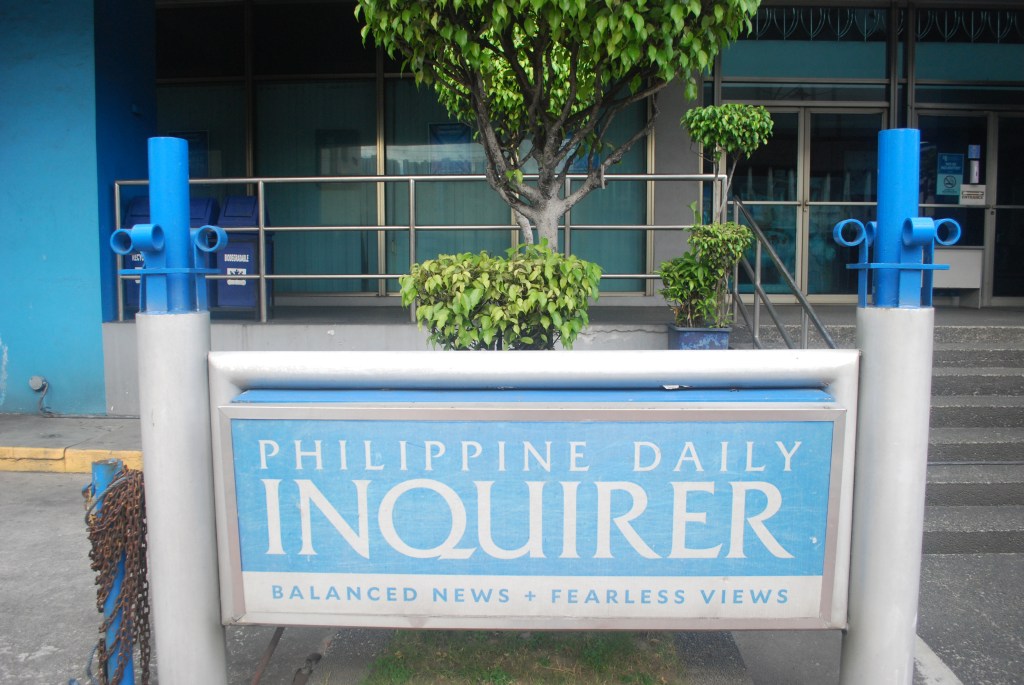
Another challenge that Miss Connie Kalalagyan had mentioned and was pretty adamant about, was the role of the government on the media (in general). She did not specifically say in detail what were the causes of these concerns but in a nutshell, she told us that the government overall had been hard on the media lately, to the point that they question themselves if the story they were initially intending of covering was still worth pursuing; if they should still continue their own and the company’s mission and vision to provide REAL information for the people. It seemed to us as if it was an extremely risky situation they were in because she had also mentioned that at the expense of providing REAL information, in return they (the media) would be ‘attacked’.
Another key point that Miss Kalagayan had stated was that the COVID-19 is playing a huge role in the (media and) print business. She was stern in telling us that this outbreak is not only local but rather it is on a global-worldwide scale. An effect of the COVID-19, is that the stock markets are going down, therefore any business for that matter, follows its decline. An example she gave was the recent mass layoff that PAL (Philippine Airlines) needed to do to their employees due to the Corona Virus tragedy. The event had taken aback their business operation and therefore needed to cut down on manpower to make up for it. She said that it was an overall 360-degree turn not only for PAL but for all companies as well. Which brings us to the next question we had for Miss Connie – “How do they pay their employees despite all these issues and challenges?”
Despite the economic factors that Miss Kalagayan mentioned, one thing salient that she stated was how their salaries and the money-making aspect isn’t a hindrance for their writers to live up to their purpose. They find purpose and happiness in telling the truth. Regular employees get regular monthly salaries while correspondents and columnists are paid per article (similar to freelancing or project-based employees). Most of the time, the employees overlook the amount of their salaries because they love their work and jobs so much that they find purpose and happiness in telling the truth; which to them is already a reward in itself.

Due to the evolution of media, alongside the challenges that they face from the collective pressure of different factors, we also asked Miss Connie Kalagayan if they still had the ‘say’ in dictating the ‘agenda’ of the newsprint that they produce. She started off by proudly saying that the Philippine Daily Inquirer is already turning 35 years old at the end of the year. And with that, she also confidently said that they are an agenda-setter. Their definition of being an agenda-setter would be that they find news that is not or has not been covered by other companies. And the thing they do differently is that they thoroughly do their research on the material before breaking out the story. Unlike other newsprint media wherein their primary goal is to be the first to release or break the story. She said:
“That’s not the style of the inquirer. The style of the Inquirer is we study; because we would like to find out if this particular big story which can probably shake up the society, “Is this something that we need to come out of it now, or is it a matter of really researching and ensuring that these whistleblowers are really telling the truth?”; that these people implicated in this case are people that are untouchable. How can we make sure if they’re untouchable, how can we make sure that later on be given justice?”
Their style is to study content first because they want to stir the country where it should be.
“So yes, if your question is “do you care if we set the agenda?” Yes, we do. And the reason why we do it is not because to steer the Philippines as to where it should go but rather to steer the country where it is meant to be.”
Lastly, we asked Miss Connie how she sees The Philippines Daily Inquirer in the future.
Their goal in the future is that they want to continue to empower the Filipino people by giving them correct information and to stir them where they should be.
“In the future we hope to continue doing our mission of being able to empower the Filipino people and by empowering the Filipino, that is providing them with information and steering their emotions so that they create action. So we hope to continue doing that because we feel if a government or if a dictator again in the future will start to muzzle us and tell not to say anything then that again I think is going to be another darkness in our history because once that fort estate the media is censored by the government then that means that you don’t have a free society, So, we hope to continue doubt that even though we get threats, curses on tv.”
 Sonder.